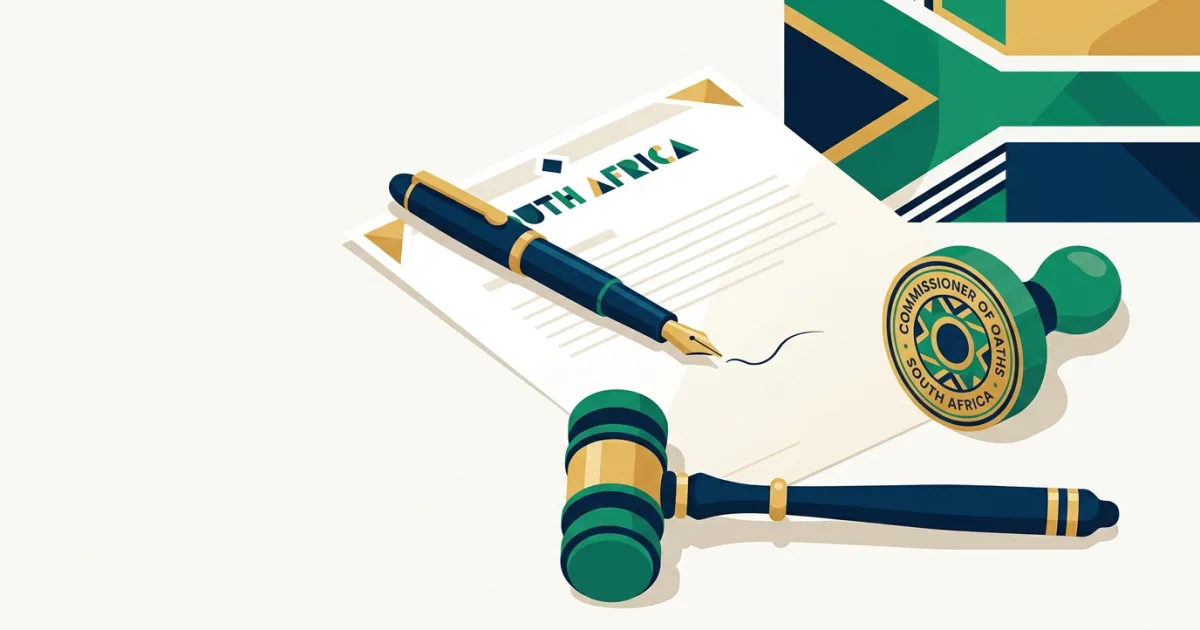
An affidavit in South Africa is a sworn written statement of facts, confirmed by oath or affirmation before a Commissioner of Oaths. It serves as legal evidence in court proceedings and for administrative purposes like proving residence or reporting a lost document. The process involves drafting the statement and then having it sworn before an authorised official.
What is an Affidavit in South Africa?
An affidavit is a formal written declaration made voluntarily under oath or affirmation. Its primary legal purpose is to present factual evidence in legal or administrative matters. Unlike a simple letter, an affidavit carries significant legal weight because the deponent swears to its truthfulness. This sworn statement is also commonly referred to as a sworn affidavit or a statutory declaration.
The core function is to provide a reliable account of facts that a person is willing to attest to under penalty of perjury. It is a fundamental tool in the South African legal system, used from small claims court to high court applications.
How to Write and Format an Affidavit Correctly
Drafting a valid affidavit requires a specific structure and adherence to key principles to ensure it is accepted by authorities and courts.
Essential Structure and Heading
A properly formatted affidavit begins with a clear heading, typically the word 'AFFIDAVIT'. If the document relates to a court case, the case number is included. The structure logically flows from identifying the deponent to stating the facts.
- Introduction (Commencement): This section must clearly identify the person making the statement with their full names, South African identity number, occupation, and residential address.
- Body (The Statements): The body contains the factual statements, presented clearly and concisely, typically in numbered paragraphs.
- Conclusion (Jurat): This final clause is completed by the Commissioner of Oaths and includes the date, place of commissioning, and the official's signature and stamp.
Key Drafting Rules to Follow
- Adhere to principles of clarity, factual accuracy, and direct knowledge.
- Avoid opinions, hearsay, or irrelevant details, and maintain a consistent first-person perspective.
- Number every paragraph sequentially to make the document easy to reference.
The Role of the Commissioner of Oaths
A Commissioner of Oaths is a person authorised by law to administer oaths and witness the signing of affidavits. In South Africa, this group includes practising attorneys, magistrates, police officers of a certain rank, and certain other designated public officials.
Their legal duty is twofold: to verify your identity (usually by inspecting your official ID document) and to witness you taking the oath or making the affirmation that the contents of the affidavit are true. They then complete the jurat by signing and stamping the document.
A critical point is that the Commissioner of Oaths does not certify or verify the truth of the statements within the affidavit. They only confirm that you, the deponent, swore to its truthfulness before them. The legal responsibility for the content lies entirely with you.
Where to Get an Affidavit Commissioned in South Africa
The public has several accessible options for finding a Commissioner of Oaths.
- South African Police Service (SAPS) Stations: This is the most common and often free service. Visit your local station during their official hours with your drafted affidavit and your green barcoded ID book, smart ID card, or passport.
- Attorneys' and Notaries' Offices: Almost all practising attorneys are Commissioners of Oaths. They typically charge a fee for this service, which can vary.
- Post Offices and Municipal Offices: Selected branches have staff who are Commissioners of Oaths available to assist the public. It's advisable to call ahead to confirm availability.
- Banks and Other Financial Institutions: Some banks have internal staff who are Commissioners of Oaths to assist with affidavits required for their own processes, such as proof of residence or identity verification.
Common Examples and Uses of Affidavits
Affidavits are versatile documents used across many legal and everyday administrative scenarios. For a professionally drafted template suitable for various needs, you can refer to a standard Sworn Affidavit.
- Proof of Residence Affidavit: Used for official processes requiring address verification, such as opening bank accounts or applying for licenses. A dedicated Proof of Residence Affidavit is often required.
- Affidavit of Lost Document: A formal declaration required when an important document, such as an ID or driver's license, has been lost, often as a prerequisite for replacement. You can use an Affidavit of Lost Document for this purpose.
- General Sworn Affidavit: Applicable for various legal and administrative needs, including court evidence, confirming events, or supporting applications.
- Unemployment or Financial Status Affidavits: Often required when applying for social grants, certain loans, or other financial assistance where you must declare your income and employment status under oath.
Fees, Validity, and Important Considerations
Understanding the practical aspects helps you navigate the process smoothly.
| Consideration | Details |
|---|---|
| Fees | Commissioning at a SAPS station is generally free of charge. Private practitioners like attorneys will charge a fee, which you should confirm beforehand. |
| Validity Period | An affidavit is valid as a record of the facts as sworn to on the specific date of commissioning. Its ongoing usefulness depends on the context; for example, a proof of residence affidavit may be considered outdated after a few months if you move. |
| Consequences of False Statements | Making a false statement in a sworn affidavit constitutes the crime of perjury. This is a serious offence that can lead to criminal prosecution, including potential fines or imprisonment. |
| Notary Public vs. Commissioner | For documents intended for use outside South Africa (like for immigration or foreign business), you will likely need the services of a Notary Public, who has additional authentication powers beyond a standard Commissioner of Oaths. |
Always ensure you have your original, valid identification document with you when going to commission an affidavit. The Commissioner cannot proceed without verifying your identity.
Your Next Step
Identify the type of affidavit you need for your specific situation. Draft your statement, focusing on clear, factual paragraphs. Once your document is ready, take it along with your original ID to a Commissioner of Oaths at a SAPS station, attorney's office, or other authorised venue to have it sworn and made legally valid.