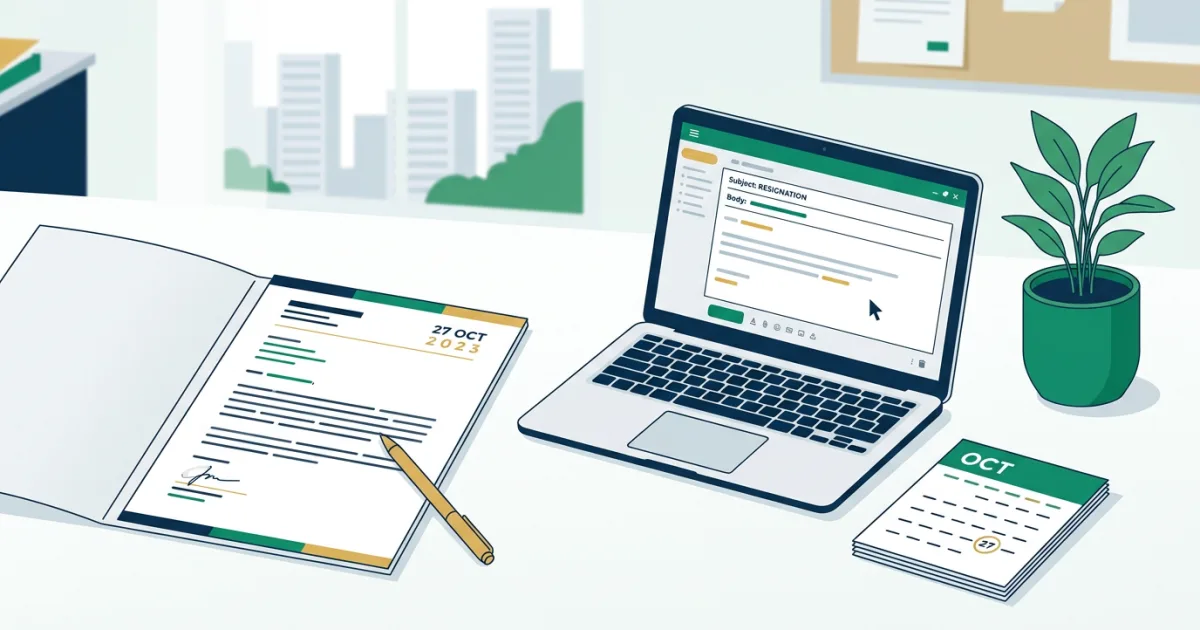
A resignation letter in Singapore is a formal written notice you give to your employer to state your intention to leave your job. It must clearly specify your last working day, which is calculated based on your contractual notice period, and serves as an important record to protect your employment rights and final salary.
What is a Resignation Letter and Why is it Important in Singapore?
A resignation letter is your official notification to your employer. It is a critical document in Singapore's professional landscape. Submitting it creates a clear, dated record of your decision. This helps prevent disputes over your final day of work and ensures your final salary and benefits, like unused annual leave encashment, are processed correctly. A professional letter also maintains goodwill, which is essential for future references.
Key Components of a Professional Resignation Letter
Every effective resignation letter, whether simple or detailed, should include these core elements:
- Your details and employer's details: Your full name, position, the company name, and your manager's or HR department's name.
- Clear statement of resignation: A direct sentence stating you are resigning from your position.
- Last working date: The exact date of your final day of employment, calculated after your notice period.
- Brief reason (optional): A positive or neutral reason like "pursuing a new opportunity" is common but not legally required.
- Expression of gratitude: Thank your employer for the experience and opportunities.
- Handover offer: State your willingness to help with the transition.
- Signature and date: Sign and date the letter on the day you submit it.
How to Calculate Your Notice Period in Singapore
Your last working day is the most important date in your letter. Calculate it correctly to avoid issues with your final pay.
Follow Your Employment Contract
Your notice period is primarily governed by your employment contract. Common periods are one month or two weeks. Always check your signed contract first.
If There Is No Written Contract
If your contract does not specify a notice period, you should follow the common practice for your role and industry or the minimum standards implied by law. It is advisable to give reasonable notice to ensure a smooth exit.
Serving Your Full Notice
You must work through your entire notice period. If you fail to do so, your employer may deduct salary in lieu of notice from your final settlement. For specific roles like a director or company secretary, check your company's constitution for any special requirements. You can use a Two Weeks' Notice Letter template if that is your required period.
Resignation Letter Example (Formal & Detailed)
Here is a template for a standard, professional resignation letter. You can adapt it to your situation and submit it as a printed letter or a PDF email attachment.
[Your Full Name]
[Your Position]
[Date]
[Manager's Name / HR Department]
[Company Name]
[Company Address]
Dear [Mr./Ms. Manager's Last Name],
Please accept this letter as formal notification of my resignation from my position as [Your Position] at [Company Name]. My last day of employment will be [Last Working Date], in accordance with the [e.g., one-month] notice period as per my employment contract.
I have truly valued my time at [Company Name] and am grateful for the professional opportunities and support I have received. Thank you for the experience.
I am committed to ensuring a smooth transition during my remaining time here. I am happy to assist with training my replacement or completing handover notes as required.
Please let me know the next steps regarding my final settlement and the return of company property.
Sincerely,
[Your Signature]
[Your Typed Name]
Simple or Short Resignation Letter Example
For straightforward resignations where you are serving a standard notice period, a concise letter is perfectly acceptable. It must still include the key elements.
Dear [Manager's Name],
I am writing to formally resign from my position as [Your Position] at [Company Name]. My last day of work will be [Last Working Date].
Thank you for the opportunity. I will do my best to ensure a proper handover of my duties.
Sincerely,
[Your Name]
How to Write a Resignation Email (With Example)
Resigning via email is common and acceptable, especially in modern workplaces. The email body should mirror the formality of a printed letter.
Email Structure and Etiquette
Use a clear subject line, such as "Resignation - [Your Full Name]". Address it to your direct manager and consider CC'ing the HR department. The body should contain all the key components of a formal letter. It is good practice to offer to provide a signed hard copy if needed.
Resignation Email Example
Subject: Resignation - [Your Full Name]
Dear [Mr./Ms. Manager's Last Name],
Please accept this email as my formal resignation from the position of [Your Position] at [Company Name]. My last day of employment will be [Last Working Date].
I want to express my sincere gratitude for the guidance and opportunities I have had during my time here. I am happy to assist with the handover process in the coming weeks.
Please advise on the procedures for my final settlement. I am available to discuss the transition further at your convenience.
Best regards,
[Your Full Name]
[Your Position]
What to Do After Submitting Your Resignation Letter
Once your letter is submitted, focus on ensuring a professional departure.
- Prepare for an exit meeting: Your manager or HR will likely want to discuss your resignation. Be prepared to discuss your reason and handover plan.
- Document handover notes: Create clear notes on your ongoing projects, responsibilities, and key contacts for your successor.
- Return company property: Gather all items like laptops, access cards, and files for return.
- Clarify final settlements: Confirm the details of your final salary, any encashment of unused annual leave, and your CPF contributions.
- Request acknowledgment: Ask for a formal written acknowledgment of your resignation from your employer for your records.
Next Step
To ensure your resignation is handled professionally and in line with common practice, use a reviewed template. A Letter of Resignation template provides the correct structure and helps you avoid common omissions.